
Rural social security death benefits:What are rural social security death benefits and who is eligible?
Q: What are rural social security death benefits and who is eligible?
A: Rural social security death benefits are payments made to the survivors of a deceased individual who was covered under the social security system, typically in rural areas where formal employment may be less common. Eligibility generally depends on the deceased's work history and the survivor's relationship to them. In most countries, these benefits are available to widows, widowers, children under a certain age, and sometimes dependent parents. For rural workers, eligibility may also hinge on participation in agricultural or informal sector schemes. The specific rules vary by country; for example, in China, rural residents may be covered under the New Rural Pension Scheme, which offers death benefits to surviving family members. In the United States, Social Security survivors benefits are available to rural and urban workers alike, provided the deceased had enough work credits. It's important to check local regulations because rural social security systems often have distinct criteria and benefit amounts compared to urban programs. Documentation such as marriage certificates, birth certificates, and proof of the deceased's contributions is usually required to claim these benefits.
Q: How do you apply for rural social security death benefits?
A: Applying for rural social security death benefits typically involves several steps. First, you should contact your local social security office or rural pension agency to report the death and request the necessary forms. You'll need to provide personal identification, the deceased's social security number, and documents proving your relationship to the deceased, such as a marriage certificate or birth certificate. In rural areas, applications may be processed through village committees or agricultural cooperatives, so start there if you're unsure. Once the forms are completed, submit them along with certified copies of the required documents. The agency will verify the deceased's contribution history and determine your eligibility. Processing times can vary; in some rural programs, it may take several weeks to a few months. Be prepared to follow up regularly, as rural offices may have limited staff. If you face difficulties, consider seeking help from a local social worker or legal aid organization. It's also wise to keep copies of all submitted documents for your records. Remember that deadlines may apply, so apply as soon as possible after the death.
Q: What factors affect the amount of rural social security death benefits?
A: The amount of rural social security death benefits depends on several factors. The most significant is the deceased's contribution record—how long they paid into the social security system and the level of their earnings. In rural areas, where incomes may be lower or seasonal, this can result in smaller benefit amounts compared to urban workers. The type of survivor also matters: a surviving spouse may receive a different amount than dependent children, and benefits for children often end at a certain age. Additionally, the specific program rules play a role. For instance, some countries have flat-rate benefits for rural residents, while others use a formula based on the deceased's average indexed earnings. In China's rural pension scheme, death benefits may be a lump sum equal to a certain number of months of the pension, or a fixed amount. Other factors include whether the survivor is also eligible for their own social security benefits, which can affect the total. Finally, cost-of-living adjustments and regional variations can influence the final amount. To get an accurate estimate, contact your local social security office with the deceased's details.
Dialogue about
Common scenarios of "Rural social security death benefits"
【Villager】 Hello, I heard that rural social security has death benefits. Can you tell me what that is?
【Social Worker】 Yes, of course. Rural social security death benefits are payments made to the family or legal heirs of a rural social security participant after their death. It usually includes a funeral subsidy and a one-time pension.
【Villager】 Who can receive these benefits?
【Social Worker】 Generally, the legal heirs or designated beneficiaries can receive them. If there is no legal heir, the person who actually paid for the funeral may apply.
【Villager】 What documents are needed to apply?
【Social Worker】 You typically need the death certificate, the deceased's social security card, the applicant's ID, proof of relationship, and a bank account for the payment.
【Villager】 How much is the funeral subsidy?
【Social Worker】 The amount varies by region, but it's usually a fixed sum, often around a few thousand yuan. You should check with your local social security office for the exact standard.
【Villager】 And the one-time pension?
【Social Worker】 The one-time pension is often calculated based on the deceased's contributions and local average income. It could be several months of the local average pension.
【Villager】 Where do I go to apply?
【Social Worker】 You can apply at the local township social security service center or the county-level social insurance bureau. Some places also allow online applications.
【Villager】 Is there a time limit for applying?
【Social Worker】 Yes, usually within a certain period after death, like 3 to 6 months. It's best to apply as soon as possible to avoid delays.
【Villager】 What if the deceased was receiving a pension already?
【Social Worker】 If they were already receiving a pension, the death benefit still applies, but the pension will stop from the month after death. Any overpayment may need to be returned.
【Villager】 What about if the person died before reaching retirement age?
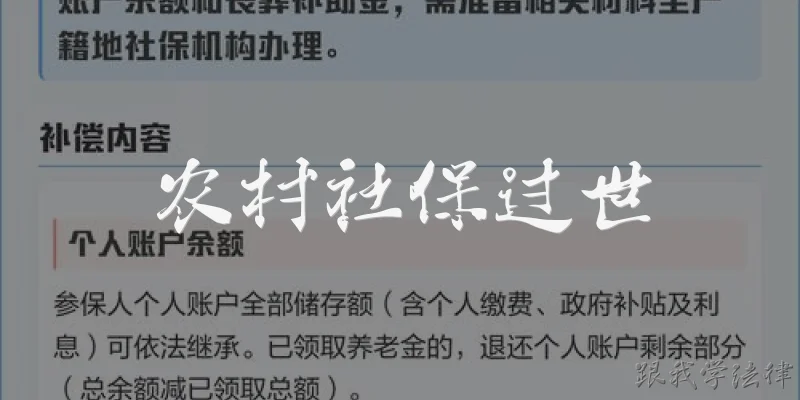
【Social Worker】 If they contributed to rural social security but died before retirement age, their personal account balance can be inherited, plus a funeral subsidy may be available.
【Villager】 Can I apply if I'm not a direct relative?
【Social Worker】 If you are not a direct relative, you may need a notarized document from all legal heirs authorizing you to apply, or you must be the actual funeral payer.
【Villager】 How long does it take to get the money?
【Social Worker】 After submitting complete documents, it usually takes about 15 to 30 working days for approval and payment.
【Villager】 What if there is a dispute among family members?
【Social Worker】 Then the social security office may require a notarized agreement or a court judgment to determine the rightful recipient before releasing the funds.
【Villager】 Is this benefit available nationwide?
【Social Worker】 Yes, it's part of the national rural social security system, but specific rules and amounts are set by local governments.
【Villager】 Thank you for explaining. I'll go to the local office to ask for details.
【Social Worker】 You're welcome. Remember to bring all necessary documents. If you have more questions, feel free to ask.