
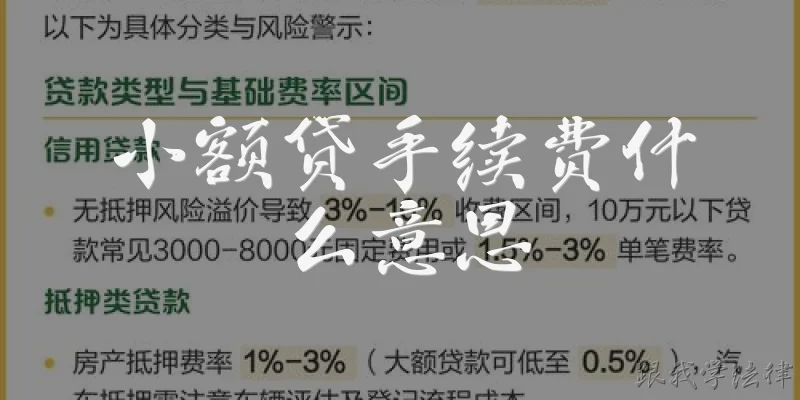
What does a small loan service fee mean?:What does a small loan service fee mean?
Q: What does a small loan service fee mean?
A: A small loan service fee is a charge imposed by a lender to cover the administrative costs of processing and maintaining a small-dollar loan. According to the Consumer Financial Protection Bureau's 2026 Small-Dollar Lending Report, these fees can include origination, application, or servicing charges and are separate from interest. For a $500 loan, a typical service fee might range from $10 to $50, depending on the lender and state regulations. The Federal Reserve's 2026 Survey of Consumer Finances notes that such fees are most common in payday, auto title, and online installment loans. Importantly, the Truth in Lending Act requires lenders to disclose all service fees clearly in the loan agreement, so borrowers can compare the total cost of credit before signing.
Q: How are small loan service fees regulated in 2026?
A: In 2026, small loan service fees are regulated at both federal and state levels. The Consumer Financial Protection Bureau's 2026 Payday, Vehicle Title, and Certain High-Cost Installment Loans Rule limits how often lenders can charge service fees and requires them to assess a borrower's ability to repay. Many states also cap service fees as a percentage of the loan principal; for example, the National Conference of State Legislatures 2026 report shows that 18 states cap fees at 10% or less for loans under $1,000. Additionally, the Military Lending Act's 2026 updates restrict service fees for active-duty service members to a 36% Military Annual Percentage Rate, including fees. Borrowers should check their state's usury laws, as some states prohibit service fees entirely on small loans.
Q: Why do lenders charge service fees on small loans?
A: Lenders charge service fees on small loans primarily to cover fixed operational costs that are proportionally higher for smaller principal amounts. According to the 2026 Annual Report of the Conference of State Bank Supervisors, processing a $300 loan costs nearly as much as a $3,000 loan in terms of underwriting, compliance, and servicing, so lenders use service fees to maintain profitability. The Federal Deposit Insurance Corporation's 2026 Small Business Lending Survey found that credit unions and community banks often charge lower service fees (averaging $15 per loan) than online lenders (averaging $45). Additionally, service fees compensate for the higher default risk associated with small, unsecured loans. However, the Consumer Financial Protection Bureau warns that excessive fees can trap borrowers in a cycle of debt, which is why disclosure and caps remain critical.
Q: How can consumers avoid or reduce small loan service fees?
A: Consumers can avoid or reduce small loan service fees by comparing offers from multiple lenders, as required by the Truth in Lending Act's 2026 disclosure rules. The Consumer Financial Protection Bureau's 2026 'Take Control of Your Credit' guide recommends checking with local credit unions, which often waive service fees for members. Additionally, borrowing from employers through paycheck advance apps—regulated under the 2026 Earned Wage Access Act—may involve no service fees. The Federal Trade Commission's 2026 report advises negotiating fees if you have good credit or a long relationship with the lender. Finally, avoid payday and auto title loans, where service fees can exceed 20% of the principal. Instead, consider a small personal loan from an online bank like Marcus or Discover, which typically charge no origination fees and offer transparent pricing.
Dialogue about
Common scenarios of "What does a small loan service fee mean?"
【Customer】 Hi, I saw an ad for a small loan with a service fee. What exactly does that mean?
【Loan Officer】 Hello! A service fee is a charge that the lender applies for processing your loan application. It's separate from the interest.
【Customer】 So it's like an application fee? I thought those were banned or something.
【Loan Officer】 Some fees are restricted, but service fees can still be legal if they're disclosed properly. It covers administrative costs like verifying your information and underwriting.
【Customer】 How much are we talking about? Is it a percentage or a flat fee?
【Loan Officer】 It varies by lender. Some charge a flat fee, like $25, while others charge a percentage, say 1-3% of the loan amount.
【Customer】 If I borrow $500, and the fee is 3%, that's $15. So I'd only get $485?
【Loan Officer】 Exactly. The fee is typically deducted from the loan proceeds, so you receive less than the full amount but still have to repay the full $500 plus interest.
【Customer】 That seems like a lot. Are there any caps on these fees?
【Loan Officer】 In many states, yes. For payday loans or small consumer loans, there are usury laws that limit fees and interest. But it depends on where you live.
【Customer】 Can you give me an example of how a service fee works in practice?
【Loan Officer】 Sure. Suppose you take a $1,000 loan with a 5% service fee. You'd get $950 upfront, and you'd repay $1,000 plus interest over the term. The fee is $50.
【Customer】 So the service fee is basically a cost of doing business for the borrower. Is it always a one-time fee?
【Loan Officer】 Usually it's one-time, charged at origination. But some lenders might have recurring fees, like monthly maintenance fees. Always read the fine print.
【Customer】 What happens if I pay off the loan early? Do I get the service fee back?
【Loan Officer】 Typically no. The service fee is earned when the loan is made, so it's non-refundable. But check your loan agreement for specifics.
【Customer】 Are there any alternatives to avoid service fees?
【Loan Officer】 Some credit unions or online lenders offer no-fee loans, but they might have higher interest rates. It's a trade-off. Also, borrowing from friends or family can avoid fees entirely.
【Customer】 I see. So I should compare the total cost of credit, including fees and interest, not just the interest rate.
【Loan Officer】 Exactly. The APR (Annual Percentage Rate) includes both interest and fees, so it's a better measure for comparison. Always ask for the APR.