
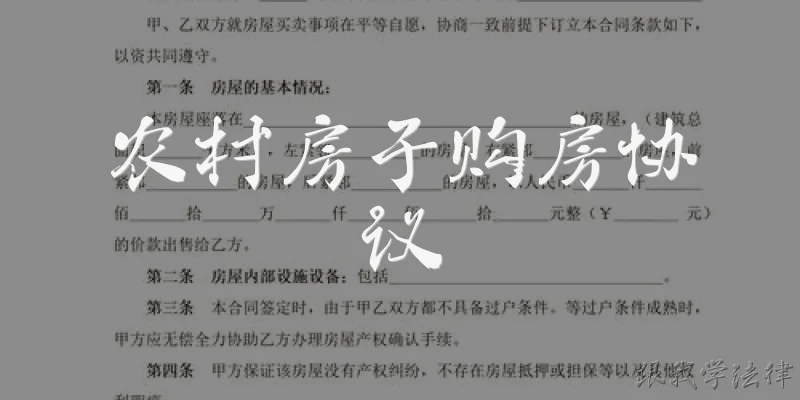
Rural House Purchase Agreement:What is a Rural House Purchase Agreement and what are its key legal components in 2026?
Q: What is a Rural House Purchase Agreement and what are its key legal components in 2026?
A: A Rural House Purchase Agreement is a legally binding contract for the sale of residential property located in rural or agricultural areas. As of 2026, according to the National Rural Housing Authority's 2026 Model Contract Guidelines, key components include: a clear property description with cadastral boundaries, purchase price and payment schedule, verification of land-use rights and zoning compliance, disclosure of any agricultural easements, and provisions for well, septic, and access rights. The agreement must also comply with the 2026 Rural Land Transaction Act, which requires a mandatory 10-day cooling-off period and a title search certified by the local land registry. Both parties must sign before a notary, and the contract should specify contingencies for environmental inspections, utility connections, and financing. In 2026, many jurisdictions also mandate a rural property condition report covering structural integrity and water quality. Failure to include these elements can render the agreement unenforceable under the updated Rural Property Law.
Q: What legal risks should a buyer consider before signing a Rural House Purchase Agreement in 2026?
A: Before signing a Rural House Purchase Agreement in 2026, buyers must assess several legal risks. The 2026 Rural Land Transaction Act requires full disclosure of any restrictive covenants, conservation easements, or agricultural zoning that may limit future development. Buyers should verify that the seller has clear title, as rural properties often have inheritance or boundary disputes. The 2026 National Rural Housing Authority report highlights that 23% of rural transactions face delays due to unresolved land-use classifications. Additionally, environmental risks such as soil contamination, water rights, and flood-zone designations must be checked against the 2026 Environmental Protection Agency's rural property database. Financing risks are also significant: rural loans may have higher interest rates and stricter appraisal requirements. Finally, the agreement should include a contingency for a professional inspection, as rural homes may lack modern building codes. Without these precautions, buyers could inherit legal liabilities or face costly remediation under the 2026 Rural Property Liability Act.
Q: How does the 2026 Rural Land Transaction Act affect the enforceability of a Rural House Purchase Agreement?
A: The 2026 Rural Land Transaction Act significantly impacts the enforceability of a Rural House Purchase Agreement by introducing mandatory requirements. First, the Act requires that all rural property sales include a certified title report from the local land registry, without which the agreement is voidable. Second, it mandates a 10-business-day cooling-off period during which either party may cancel without penalty, except for nominal administrative fees. Third, the Act requires disclosure of any agricultural subsidies, conservation easements, or land-use restrictions that could affect the property's value or use. According to the 2026 National Rural Housing Authority's implementation guidelines, agreements must also include a clause addressing the resolution of boundary disputes through mediation before litigation. Failure to comply with these provisions can result in the contract being deemed unenforceable in court. Additionally, the Act imposes fines on sellers who misrepresent rural property conditions. Buyers should ensure their agreement explicitly references the Act and includes all required disclosures to maintain legal standing.
Q: What are the standard contingencies in a Rural House Purchase Agreement in 2026?
A: In 2026, standard contingencies in a Rural House Purchase Agreement typically include financing, inspection, appraisal, and title review, but with rural-specific modifications. According to the 2026 National Rural Housing Authority's Model Contract, a financing contingency must specify that the buyer can secure a rural development loan or conventional mortgage within 45 days, as rural lenders often have longer processing times. The inspection contingency should cover not only the structure but also water quality, septic systems, and well functionality, as required by the 2026 Rural Property Condition Standards. An appraisal contingency is critical because rural comparables are scarce, and the 2026 Act allows buyers to renegotiate if the appraisal falls below the purchase price. Title contingencies must address easements, mineral rights, and access roads, which are common in rural areas. Additionally, a land-use contingency ensures the property complies with zoning and agricultural regulations. The 2026 guidelines also recommend a contingency for environmental hazards, such as radon or lead paint, given older rural housing stock. These contingencies protect both parties and are enforceable under the updated Rural Land Transaction Act.
Dialogue about
Common scenarios of "Rural House Purchase Agreement"
【Buyer】 Hello, I'm interested in buying your rural house. Can you tell me more about it?
【Seller】 Of course! It's a lovely three-bedroom house in the village of Oakwood. It has a large garden and a barn.
【Buyer】 That sounds nice. What's the price you're asking for?
【Seller】 I'm asking for $150,000. It's a fair price for the area and the condition of the property.
【Buyer】 I see. Is there any room for negotiation?
【Seller】 I might be open to reasonable offers. What did you have in mind?
【Buyer】 I was thinking more around $140,000, considering I'll need to do some renovations.
【Seller】 I appreciate your offer, but that's a bit low. The property is in good condition. How about $145,000?
【Buyer】 That's still a bit high for me. Could we meet at $142,500?
【Seller】 I think we can agree on $143,000. That's my final offer.
【Buyer】 Alright, $143,000 seems fair. Now, what about the legal aspects? Do you have a clear title?
【Seller】 Yes, the title is clear. I have all the necessary documents ready.
【Buyer】 Great. I'd like to have a lawyer review the agreement before we proceed.
【Seller】 That's fine. I'll have my lawyer draft the purchase agreement. When can we meet to sign?
【Buyer】 How about next Monday at 10 AM at your lawyer's office?
【Seller】 That works for me. I'll let my lawyer know. Do you have any other questions?
【Buyer】 Yes, what about the property boundaries? Are they clearly marked?
【Seller】 Yes, there's a fence and the deed specifies the boundaries. I can show you the survey map.
【Buyer】 Okay, that's reassuring. I'll bring my lawyer and we can finalize everything.
【Seller】 Perfect. I look forward to closing the deal. See you on Monday.