Is the New Rural Cooperative Medical Scheme rural health insurance?:Is the New Rural Cooperative Medical Scheme considered a form of rural health insurance?
Q: Is the New Rural Cooperative Medical Scheme considered a form of rural health insurance?
A: Yes, the New Rural Cooperative Medical Scheme (NRCMS) is a form of rural health insurance. Established by the Chinese government in 2003, it is a voluntary, government-subsidized health insurance program specifically designed for rural residents. The scheme operates on a mutual aid model, pooling funds from individual contributions, collective support, and government subsidies to cover major medical expenses. While it shares characteristics with other health insurance models, such as risk pooling and reimbursement for medical costs, it is unique in its rural focus and reliance on government funding. Therefore, the NRCMS is widely recognized as a rural health insurance scheme aimed at improving healthcare access and financial protection for farmers and their families.
Q: What are the key features that make the New Rural Cooperative Medical Scheme a rural health insurance program?
A: The New Rural Cooperative Medical Scheme (NRCMS) is a rural health insurance program due to several key features. First, it targets rural residents exclusively, addressing their specific healthcare needs. Second, it is voluntary, allowing farmers to enroll and pay a small premium, which is matched by government subsidies. Third, it covers mainly inpatient and some outpatient services, reimbursing a portion of medical costs. Fourth, it operates at the county level, with risk pooling across participants to spread financial risk. These features align with the core principles of health insurance: risk sharing, premiums, and coverage. Thus, the NRCMS functions as a rural health insurance mechanism, distinct from urban employee or resident insurance schemes.
Q: How does the New Rural Cooperative Medical Scheme differ from other rural health insurance models?
A: The New Rural Cooperative Medical Scheme (NRCMS) differs from other rural health insurance models primarily in its governance and financing. It is a government-led, voluntary program with heavy subsidies from central and local governments, whereas some other rural insurance models might be community-based or private. The NRCMS also focuses on catastrophic illness coverage, with reimbursement rates varying by level of care. Unlike commercial rural health insurance, it does not aim for profit and emphasizes equity and access. Additionally, the NRCMS is integrated into China's broader social security system, often coordinating with urban insurance schemes. These distinctions make it a unique hybrid of social and mutual aid insurance, tailored to rural contexts and government policy goals.
Q: Is the New Rural Cooperative Medical Scheme still operating as a rural health insurance program today?
A: As of recent years, the New Rural Cooperative Medical Scheme (NRCMS) has been largely integrated into China's Urban and Rural Resident Basic Medical Insurance (URRBMI) system. Since 2016, many provinces merged the NRCMS with urban resident insurance to create a unified scheme for both rural and urban residents, aiming to reduce disparities. However, in some areas, the NRCMS may still exist in practice or under transitional arrangements. Despite this integration, the NRCMS historically functioned as a rural health insurance program and its principles continue in the merged system. Thus, while the original standalone NRCMS is being phased out, its legacy as rural health insurance remains, and the current URRBMI still serves rural populations with similar coverage.
Words of experience
Common scenarios of "Is the New Rural Cooperative Medical Scheme rural health insurance?"
【Alex】 Hey, I've been reading about China's healthcare system. I keep hearing about the New Rural Cooperative Medical Scheme. Is that basically rural health insurance?
【Dr. Li】 Yes, that's a good way to put it. The New Rural Cooperative Medical Scheme, often abbreviated as NRCMS, is a voluntary health insurance program specifically designed for rural residents in China.
【Alex】 So it's insurance? Like, people pay premiums and get coverage?
【Dr. Li】 Exactly. It's a subsidized voluntary insurance scheme where individuals pay a small premium, and the government provides significant subsidies. It covers a portion of medical expenses for rural participants.
【Alex】 When was it established?
【Dr. Li】 It was launched in 2003 and gradually rolled out across rural China. By 2008, it had achieved near-universal coverage among the rural population.
【Alex】 What does it cover? Like hospital visits, medications?
【Dr. Li】 It primarily covers inpatient care, some outpatient services, and designated medications. The coverage varies by region, but it's meant to reduce catastrophic health expenditures for rural families.
【Alex】 Is it the same as the Urban Employee Basic Medical Insurance?
【Dr. Li】 No, they are separate schemes. Urban Employee Basic Medical Insurance is for urban employed individuals, while NRCMS targets rural residents. However, in recent years, China has been merging NRCMS with urban resident insurance to form a unified resident basic medical insurance system.
【Alex】 So it's not purely rural anymore?
【Dr. Li】 Correct. Since 2016, many regions have integrated NRCMS with Urban Resident Basic Medical Insurance to create the Urban and Rural Resident Basic Medical Insurance. But historically, NRCMS was the main rural health insurance.
【Alex】 How is it funded?
【Dr. Li】 It's funded through a combination of individual contributions, government subsidies at various levels, and sometimes collective support from local communities. The government subsidy makes up the majority of the funding.
【Alex】 Do participants have to pay a premium?
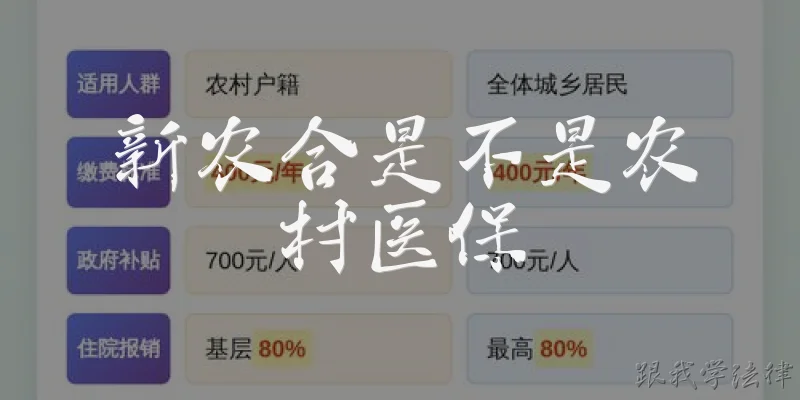
【Dr. Li】 Yes, but the premium is relatively low and subsidized. For example, in many areas, an individual might pay around 100-300 yuan per year, while the government subsidizes a similar or larger amount.
【Alex】 What about reimbursement rates? Are they high?
【Dr. Li】 Reimbursement rates vary but typically range from 50% to 70% for inpatient care at county-level hospitals, with lower rates for higher-level hospitals. There are also ceilings on total reimbursement.
【Alex】 So it's not full coverage?
【Dr. Li】 No, it's not full coverage. It's designed to provide basic financial protection. Many rural families still face out-of-pocket expenses, but it has significantly reduced the burden of catastrophic health costs.
【Alex】 Has it been successful?
【Dr. Li】 Overall, yes. It dramatically increased healthcare utilization among rural residents and reduced impoverishment due to medical expenses. However, challenges remain, such as fragmentation and unequal benefits across regions.
【Alex】 So to sum up, NRCMS is indeed a form of rural health insurance, right?
【Dr. Li】 Absolutely. It's a government-subsidized voluntary health insurance program for rural populations, and it's a key component of China's social health insurance system.